Monday, August 3, 2020

Compassionate Communication with the Memory Impaired

I did not write this ... sharing ...

         DON’T

  •   Don’t reason

  •   Don’t argue

  •   Don’t confront

  •   Don’t remind them they forget

  •   Don’t question recent memory

  •   Don’t take it personally

  • DO

  •   Give short, one sentence explanations

  •   Allow plenty of time for comprehension, then triple it

  •   Repeat instructions of sentences exactly the same way

  •   Eliminate “but” from your vocabulary, substitute “nevertheless”

  •   Avoid insistence – try again later

  •   Agree with them or distract them to a different subject or activity

  •   Accept the blame when something is wrong (even if it’s a fantasy)

  •   Leave the room, if necessary, to avoid confrontations

  •   Respond to the feelings rather than the words

  •   Be patient and cheerful and reassuring. Do go with the flow

  •   Practice 100% forgiveness. Memory loss progresses daily

  •   My appeal to you: Please elevate your level of generosity and graciousness.

REMEMBER

You can’t control memory loss, only your reaction to it. Compassionate communication will significantly heighten quality of life.

They are not crazy or lazy. They say normal things, and do normal things, for a memory impaired, dementia individual. If they were deliberately trying to exasperate you, they would have a different diagnosis. Forgive them... always. For example: they don’t hide things; they protect them in safe places... and then forget. Don’t take “stealing” accusations personally.

Their disability is memory loss. Asking them to remember is like asking a blind person to read. (“Did you take your pills? “ “What did you do today?”) Don’t ask and don’t test memory. A loss of this magnitude reduces the capacity to reason. Expecting them to be reasonable or to accept your conclusion is unrealistic. (“You need a shower.” “Day care will be fun.” “You can’t live alone.”) Don’t try to reason or convince them. Give a one sentence explanation or search for creative solutions. Memory loss produces unpredictable emotions, thought, and behavior, which you can alleviate by resolving all issues peacefully. Don’t argue, correct, contradict, confront, blame, or insist.

Reminders are rarely kind. They tell the patient how disabled they are ̶ ̶ over and over again. Reminders of the recent past imply, “I remember, I’m okay; you don’t, you’re not.” Ouch! Refer only to the present or the future. (If they’re hungry, don’t inform them they ate an hour ago; offer a snack, or set a time to eat soon.) They may ask the same question repeatedly, believing each time is the first. Graciously respond as if it’s the first time. Some days they seem normal, but they’re not. They live in a different reality. Reminders won’t bring them into yours. Note: For vascular dementia, giving clues may help their recall. If it doesn’t work, be kind... don’t remind.

Ethical dilemmas may occur. If, for instance, the patient thinks a dead spouse is alive, and truthful reminders will create sadness, what should you do? To avoid distress, try these ways of kindness: 1) distract to another topic, 2) start a fun activity, or 3) reminiscence about their spouse, “I was just thinking about __________.” How did you two meet? You might even try, “He’s gone for a while. Let’s take our walk now.”

Open-ended questions (Where shall we go? What do you want to eat/wear/do?”) are surprisingly complex and create anxiety. Give them a simple choice between two items or direct their choice. “You look great in the red blouse.”

They are scared all the time. Each patient reacts differently to fear. They may become passive, uncooperative, hostile, angry, agitated, verbally abusive, or physically combative. They may even do them all at different times, or alternate between them. Anxiety may compel them to shadow you (follow everywhere). Anxiety compels them to resist changes in routine, even pleasant ones. Your goal is to reduce anxiety whenever possible. Also, they can’t remember your reassurances. Keep saying them.

Call the Alzheimer’s Association Helpline if you need suggestions on handling challenging situations. 800-272-3900
© Liz Ayers, A volunteer of the Alzheimer’s Association Orange County Chapter and former caregiver

Saturday, July 25, 2020

Alzheimer's and COVID

Tom is 60 years old. He was officially diagnosed with Early-Onset (Younger Onset) Alzheimer's when he was 59 years old. He was diagnosed with Mild Cognitive Impairment when he was 57 years old. Alzheimer's is a progressive terminal illness so he had showed signs for a long time; I guess we would need to say years.

The undiagnosed and secretive years were particularly hard. Those were the years Tom felt like he was loosing his mind and he was letting everyone around him down: work colleagues, family, friends, himself. Those were the years before diagnosis and I kept trying to make things better on every level and nothing worked. My frustration and anger were real. In Fall of 2018, we went public and Tom received the official diagnosis. Everything changed in that moment.

We are in a good place right now and some of that is due to COVID.

  • Wills: Right before COVID hit, we completed all new Wills and various legal documents with a trusted elder care attorney
  • Finances: I did some research and decided we had a shot at applying for LTD with Tom's prior employer. With tenacity, I started the process and I was meticulous in managing the qualifications and application. Tom was approved and with a retro payment to effective date! To say we were shocked was an understatement. We now have SSDI payments for both Tom and Noah and an additional LTD benefit for Tom. I also found a little known COBRA extension for certain SSDI recipients so we have healthcare until next Spring.
  • Driving: Tom was already heavily restricted with driving and COVID sped up (pun intended) the decision for him to no longer drive. Tom was able to make this decision without stress. With COVID, he does not go anywhere so it has no real impact in our current day-to-day living situation. We traded in both of our Prius cars and I got a new hybrid which made me super happy!
  • Medicines: Oh man, the management of meds is NOT fun especially with Tom's sensitive digestive system. We have finally got him down two meds for cardiovascular health and back to a therapeutic dose of his brain med (Donepezil/Aricept.). And he is no longer on anything for mental health.
  • Vacation: Tom does best when we are in our home of 25 years where all is familiar which is key coping strategy for loved ones with dementia. SO, when we (boys helped!) planned a Colorado social distancing get-a-way last month, we were very thoughtful about how we would go about it. I am thrilled to say all went very well. We had a great time and Tom was able to enjoy himself without too much confusion and anxiety.
  • Support: The Center for Brain Health has been our lifeline to our new community: the community of families whose loved one has dementia. We meet weekly on Zoom. When Tom meets on Thursdays, I can hear him laughing and talking. It is important to have friends who really and truly understand.
  • Tom's Current State: Tom's physical health is good other than his eating habits being impacted, some loss of weight and sleeping allot. Tom's executive functioning and short term memory continue to decline. His "in the moment" cognitive level is still great thus daily interactions with him feel mostly normal. Thankfully, his self-care is high functioning. Tom's sense of humor and core essence is still there! It is really about meeting Tom where he is and expecting nothing more. When we do this then all of us function peacefully. It is about a life of worth and respecting that paradigm for everyone.
Since March we have practiced social distancing. Sam and Noah do the grocery shopping for things not delivered. We have very little interaction with extended family or friends and when we do it is done with caution and respect for not exposing ourselves to COVID. Sam and Noah have been incredible - truly. It is not easy to be 18 and 20 and not see your friends at all - for months. We did not ask them to do this; this was a decision they made and they manage. If Tom gets COVID, it would be horrific on every level. If I get COVID, the impact to our family and my business could be crippling.

HOWEVER, COVID has given our family priceless gift of time together. I would have never imagined our family of four would have this kind of time together at this stage of Tom's illness when we can still interact in positive and joyful ways.  Both boys have had internships they could do online and remote. Since I work from home 100%, it is much easier for me to be there for Tom in the ways he needs. Right before COVID hit, I was starting to feel quite overwhelmed with the care taking that was surfacing.

The Future
Our simplified approach to staying COVID safe is going to change in near future. Sam will go back to college which will make Tom incredibly sad and we will not see Sam until November. We will worry for Sam's health. Noah will go back to high school for his Senior year - maybe, probably, who knows?!? Noah's private school will be able to execute in a safe way but Noah will still be "out there." Noah also wants to get a job so we will see where that lands. While Tom and I will continue to social distance and Noah will practice safe measures (masks, sanitizer, etc.), we will have to figure out how to manage inside our home as Noah comes in and out. I do not know what our protocol decisions are yet. We will consciously do the best we can to stay safe and healthy knowing the stakes are not only life and death but a potentially tragic acceleration to the ravages of Alzheimer's.
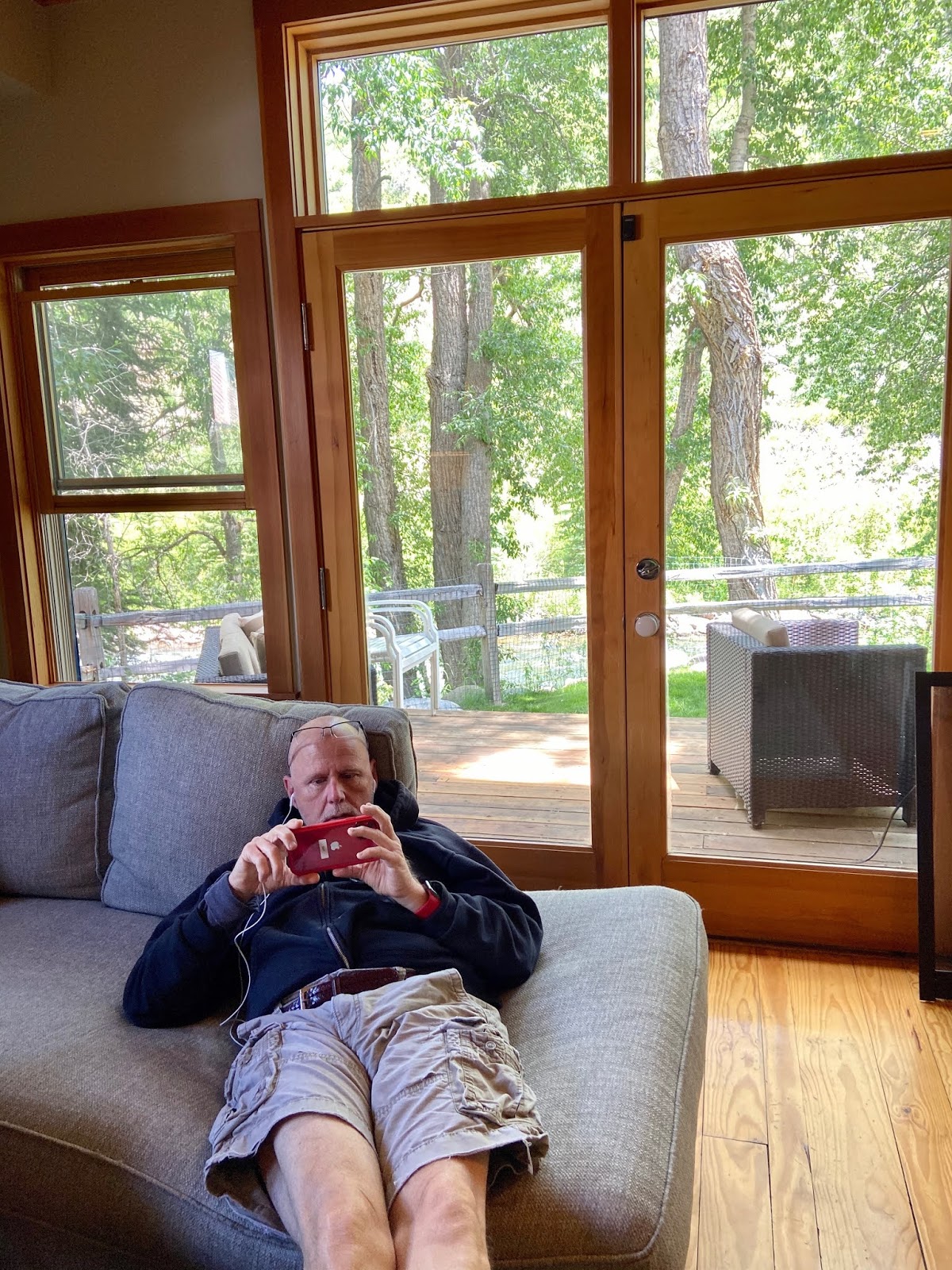
Tom manages his phone very well so likes to watch old favorites, visit museum sites and listen to music.

Making Smores indoors on vacation!

Lots of nice hiking in Colorado!

Voting!

Sunday, April 26, 2020

Our Love on Sunday Mornings

Couples who have been together for many years fall into patterns that show their love for each other. Tom and I have ours. Ours are the same and they are changing. As I type that sentence, I tear up.

On this beautiful Sunday morning, Tom brings me coffee in bed in a favorite coffee mug. He has brought me coffee for years. For those of you familiar with love languages, mine is overwhelmingly Acts of Service.
This mug means the world to me. It was a gift by my youngest niece in a difficult year.
And a new act of love has entered our world. On Sunday mornings, Tom fills his pill box independently with perhaps a few questions. Once he finishes, he brings to me to check since we are at the stage where I do monitor to make sure he stays safe. During the week, he remembers to take medications without prompting. I will check with him just to make sure but typically he does well.

Last Sunday, Tom told me he "loved this pill box" and thanked me for getting for him.  I got this new version of the pill organizer for him last Fall when I could see that his medications were not being taken correctly using the one he had. Simple things like this help keep independence longer which is incredibly important on so many levels.
This is an effective organizer for loved ones with dementia. The colors, symbols and dividers with separate lids make it easy to use.

Most of us start with romantic love and I suppose some couples maintain it for a lifetime. Many of us evolve to an enduring love that is shows abundantly in both the everyday things and the inimitable moments.

Saturday, April 25, 2020

All We Need Is Love ... Or At Least It Helps

All of this.
I belong to a Closed/Private Facebook Group "Early-onset/Young Alzheimers Female Spouses Caregiver Support Group." It is is a virtual, online Support Group. There are so many personal emotions and thoughts shared in a safe place: devastating heartbreak, joyous celebrations, comedic relief, survival techniques, complete hopelessness, utter desperation, timeless love, intense anger and and profound empathy. Our hashtag is #WeWalkThisTogether

The graphic above was posted in that Group today. Sometimes I am kinda embarrassed that Alzheimer's has brought out an approach to relationships that I could have and should have practiced without a brain disease as the driver. I do recognize that "should have" is dicey emotional ground and can lead to shame which is a spiral to negativity. I am well on my way to accomplishing most of the above with Tom. And some of those behaviors are slowly making their way into my other relationships.

This post is really about love. It is about meeting those we love where they are. It is about the brokenness that many of us harbor and figuring out how to get past it. It is about finding peace. I think #WeWalkThisTogether is what we all really need - right?

We share our very personal story because honesty pulls us together. It binds us. It shows that the human condition is there in all of us.

My sweet solace today is that Tom can write (he composed without any help!) me a love letter for my birthday:

And my love for Tom ... today I set him up outside with his laptop, pillows and covers to watch Temple-Emanu El's morning Shabbat service because I KNOW the rhythms, the sounds, the words and the prayers will ring familiar and make him happy.
I helped Tom set aside his broom and take a moment.

Listening to prayers as they are chanted in Hebrew in Live Facebook connection ...

Saturday, April 18, 2020

April with Tom and COVID

Enjoying the outdoors. 
Early-Onset Alzheimer's Disease (EOAD) is a disease of progressive decline. Like others, COVID-19 has interrupted our normal. We seek worth in the day and in the moments.

Tom's state of mind is positive.

  • Tom says "I am really happy right now."
  • And this "I love watching those movies with the boys."
  • And an excerpt from his heartfelt birthday letter to me "I also appreciate you keeping me busy around the house. It greatly enhances my sense or worth knowing that I can still add some value that helps the family."

We have accomplished some practical steps to getting our affairs in order.

  • Tom has been approved for Social Security Disability Insurance (SSDI) thus both Tom and Noah are receiving monthly benefits. There is an UNBELIEVABLE two year Medicare waiting period from SSDI effective date (tell Congress that this is not okay!) However, I stumbled across a little known legislative provision that when you have SSDI then you can extend COBRA benefits for eleven months (so many conditions to be eligible - clearly no intent from Congress to make widely available.) So while COBRA is crazy expensive, our family now has healthcare through April 2021. Thank goodness!!!! This is truly a point of great worry and anxiety for me.
  • We have signed our wills and associated documents updated for Tom's EOAD right before Stay in Place took hold ... huge relief!
  • I am now working on Long-term Disability application with Tom's former employer ... crossing my fingers.
We are also staying connected with our Alzheimer's support group via Zoom. We have a group of eight couples we met in our Center for Brain Health Discovery class last Fall. In this group, the men all have some form of dementia (3 with EOAD, 2 with Alzheimer's, 1 with Parkinson's, 1 with Lewy Body, 1 with Primary Progressive Aphasia.) We meet every Monday morning as couples. On Thursdays, the men meet with a facilitator. Tom is incredibly comforted by this group. It is important that he has a place where honest and safe expression can exist.

Tom's executive functioning and short-term memory are in decline. Imagine .... not being able to hold new information in your brain ... not being able to remember a sequence of two steps just told to you ... not being able to follow a group conversation ... not knowing what to say in group conversation ... losing periods of time ... foods tasting differently ... not being able to process written directions ... brain connectors not processing how objects seen ... fatigue ever present requiring at least 12 hours of sleep per night and naps too ... inability to track a Calendar or anything scheduled ... every action taking SO much longer than normal ...

Also imagine this INCREDIBLE gift before us. We have 7 days a week and 24 hours a day with our young adult children! Tom has this time with Noah and Sam and they with him. They are working their way through super-hero, Marvel and action movies on the Disney channel. Tom is able to relive these theater experiences he has shared with our sons throughout their life. This brings GREAT joy to Tom.

Warning - Frank Convictions Below This Line
We believe Tom is at COVID-19 high risk at age 60 and with diminished physical well-being due to EOAD. We are compliant with all Stay in Place provisions and sanitize everything. Noah and Sam have been so thoughtful and mature. They understand completely that they cannot be out and about which puts us all at risk. I am incredibly proud of them. Honesty, I feel resentful of the Americans including many in my own community who think COVID-19 is overblown, who think a loss of lives is okay and who support leaders without courage. I am fearful my husband will end up on a ventilator and we will be faced with decisions via paperwork we JUST signed with life saving measure directives. Our country is depressingly divided ... I just cannot nor will I ever nor do I want to accept what I read, hear and see daily ... what so many people think is tolerable is incomprehensible to me and fills me with hopelessness. It comes down to loving our neighbor ... that is everything. We are approaching 40,000 deaths in USA since February 29th (!) which is on average over 800 per day which is over 34 per hour. I AM thankful for the brave leaders who have boldly put our safety and truthfulness first ... we would be in much worse shape without their leadership.

Thursday Zoom with Dementia Men's Support Group ... important connection for Tom with an amazing group of loving men.

Tom is cold all the time these days.